


Clicks are up, but are qualified leads? Your lead-gen forms are full, but are you retaining those clients?
For many professional services firms, this is the core frustration. You are chasing surface-level metrics but failing to build a brand that endures and drives real growth. The problem isn’t the data; it’s the focus.
The new benchmark for success lies in shifting from a “metric-first” mindset to a systematic, “people-first” marketing strategy. This is what guides a firm to build an identity centered on understanding and connecting with customers on a deep, emotional level.
This comprehensive approach prioritizes uncovering customer needs and values, ensuring that the brand narrative aligns perfectly with what the audience needs and expects. Ultimately, firms thrive when they position their expertise as the essential solution to their prospect’s most pressing problems. This rigorous, systematic work, often categorized as a comprehensive situation analysis, is the non-negotiable foundation that sets market leaders apart.
This analysis is typically broken down into five core steps.
Step 1—Discover What Your Customers Really Think
The foundational step is to understand what your customers and prospects genuinely think and feel. This process involves a deep, qualitative dive to illuminate hidden insights, motivations, and brand blind spots that standard surveys often miss.
Why It’s Critical: Acquiring a new customer is 5 to 25 times more expensive than retaining an existing one. A formal customer perception analysis is the primary tool for retention because it uncovers the hidden friction points that lead to churn. Bain & Company research shows that increasing customer retention by just 5% can boost profits by 25% to 95%. This moves a business from guessing what customers want to knowing what they value. For example, a project management SaaS company we worked with recently was suffering from high churn. A customer perception analysis revealed the problem wasn’t the product but an overly complex onboarding process. By overhauling that initial experience with dedicated specialists, they directly addressed the hidden friction and improved retention.
Step 2: Stop Talking to Everyone, Start Connecting with “The Right One”
Once you understand general perception, the next step is to get specific. This moves beyond surface-level demographics and dives deep into the psychographic nuances and behavioral drivers of your ideal customer. This specificity is what separates resonant brands from forgettable ones.

Why It’s Critical: Generic marketing is inefficient. A thorough target market analysis is the foundation for personalization, and according to McKinsey & Company, personalization can lift revenues by 5-15%. This analysis allows a firm to stop speaking in “vanilla” generalities and instead craft messages that make ideal clients feel seen, understood, and confident enough to pay a premium for actual expertise. For instance, one of our commercial real estate brokerage clients, struggling with generic messaging, recently engaged us to develop a target market analysis to segment their audience. We discovered that their tech startups’ customer base valued flexibility (“Scalable Spaces”) while the law firms’ market segment valued prestige (“Prestigious Addresses”). By incorporating these findings into their integrated marketing plan, this targeted approach dramatically increased their qualified leads.
Step 3: Find and Fix the Friction in Your Customer’s Journey
Understanding who your customer is and what they think is essential. Now, you must map how they interact with you. In a modern business, it’s rare for a single individual to possess a complete, 360-degree understanding of the entire customer experience.

Why It’s Critical: A Salesforce report found that 76% of customers expect consistent interactions across departments, yet they rarely receive them. The process of customer journey mapping creates a visual, holistic view of every touchpoint. It is the single best tool for exposing the gaps, friction points, and silent periods—like a slow handoff between sales and service—that cause frustration and lead to lost business. A great example is an estate planning law firm that engaged with us because they were losing prospects after what seemed to be a great consultation. A customer journey map revealed the friction point. It was a cold, intimidating 15-page legal document. By adding a personal summary email and a 15-minute paralegal walkthrough, they reduced intimidation and significantly increased conversions.
Step 4: Turn Your Website from a Digital Brochure into a Conversion Engine
After rigorously defining the customer and their journey, the focus must shift to the primary digital storefront where that journey often begins or ends—the website. This is where your brand’s emotional connection meets its technical performance.

Why It’s Critical: You don’t get a second chance at a first digital impression. Research shows that online consumers are less likely to return to a site after a bad experience. A comprehensive website audit is not just a technical check-up; it scrutinizes user experience, conversion rates, content, messaging, and SEO to ensure your digital “front door” is actually built for the people you want to attract. Take, for example, another recent Marketing Direction client, a consulting solutions firm that addresses opportunities facing financial institutions. An audit revealed their site was nearly “invisible” on Google for key search terms and was not mobile-friendly, despite 70% of their target demographic searching on phones. A technical and content overhaul, focused on local SEO and a “mobile-first” design, made their “Book a Consultation” button effective.
Step 5: Stop Wasting Leads and Plug Your “Leaky Bucket”
Finally, you need a quantitative tool to ensure the entire journey, from awareness to advocacy, is efficient. Many businesses have a “leaky bucket,” spending heavily on advertising to generate leads while ignoring the holes where those leads fall out.
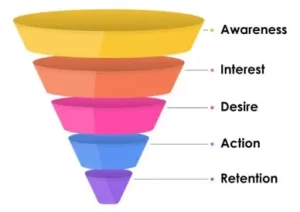
Why It’s Critical: A detailed sales funnel analysis pinpoints precisely where prospects drop off, allowing you to plug revenue leaks and improve conversion rates. Data shows that nurtured leads generate, on average, a 20% increase in sales opportunities compared to non-nurtured leads. This analysis identifies where, when, and how to nurture leads effectively. For example, an insurance agency we’re engaged with saw 75% of users abandon its “Get a Quote” form. A sales funnel analysis pinpointed the leak. The form asked for high-friction data (like a driver’s license number) too early. By splitting the form into two simple steps, they captured the basic lead info first and tripled their lead capture rate.
Final Thoughts—The Psychological Advantage
The fundamental shift toward a people-first strategy is not just a trend; it reflects a core understanding of human behavior. We inherently buy from people we know, like, and trust. If that relationship cannot be built, product excellence alone is insufficient.
By committing to the rigorous, systematic work of understanding customer perception, defining the target market, mapping the full customer journey, and optimizing your digital platforms and sales funnel, firms can move from guessing to knowing. This approach ensures your brand is positioned as the essential, tailored solution, driving unmatched credibility and securing long-term success.